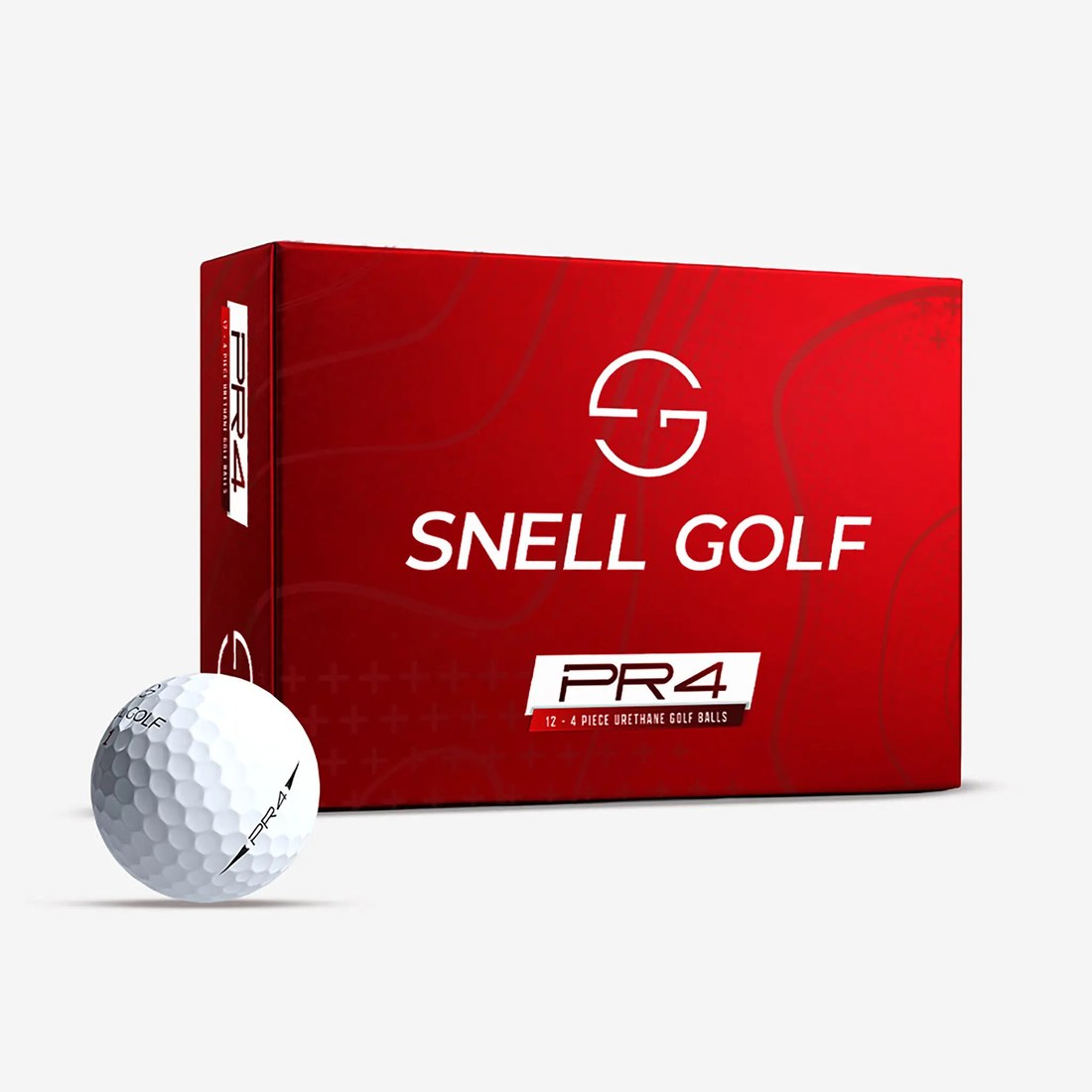
Snell built the PR4 for speed, and in testing it delivered: no ball in a 48-model field went farther off the driver at tour swing speed. Then a lab cut some open, and the story got more complicated.
What's new
The PR4 arrived in April 2026 as the faster, lower-spinning half of Snell's urethane pair. Its sibling, the PR3, leans toward control, while this ball chases distance for players with mid-to-high swing speeds.
Inside sit a high-speed, low-spin core and expanded high-energy mantles, wrapped in a TPU-X urethane cover. Compression runs 85 to 90, firm by most standards, and the price sits in the value tier, well below the premium tour balls.
How it plays
Distance scores 9.1, and it earns every tenth. In a 48-ball test, the PR4 measured longest off the driver at the fastest swing speed, with below-average spin and a high, full trajectory.
Feel and workability both land at 8.1. Off the face it feels mid-firm, the urethane grabs enough around the greens to stop chips, and accuracy at 7.8 is respectable if not class-leading. Value scores 9, which fits a tour-style build at this price.
Where it lacks
Manufacturing consistency raises real doubts. One lab scored the PR4 76 out of 100 and gave it a C with a not-recommended tag, after finding a pole-to-seam shape bias in all 36 balls it measured and grading compression symmetry an F.
Some of that report reads better. Compression consistency rated B+, and 97.2 percent of the sample passed as good balls, so most of what you tee up should play fine. A golfer who wants every ball identical will still have doubts, and Snell lacks the tour credibility to wave them away.
“Nothing in the test went farther at tour speed. I just wish the factory matched the core.”- The Club Stand gear team
Reasons to buy
- Longest off the driver at the fastest swing speed in a 48-ball test, launching on a high, full flight
- Four-piece urethane construction at a price well under what the premium tour balls ask
- Mid-firm feel and greenside spin that hold up well against other balls in the value tier
Reasons to think twice
- Lab testing found a pole-to-seam shape bias in all 36 balls sampled, which points at the manufacturing process
- Compression symmetry earned an F, so one ball out of the sleeve can feel different from the next
- Snell still has a far smaller tour presence than the brands it prices itself against
Specs
| Construction | Four-piece urethane, TPU-X cover |
|---|---|
| Compression | 85-90 (firm) |
| Core | High-speed low-spin core for distance |
| Mantle | Expanded high-energy mantles for ball speed |
| Best for | Mid-to-high swing speed players who want tour distance at a value price |
More balls we've scored
- Maxfli Tour X LS 2026 - 8.8/10. Maxfli's lower-spin Tour X, built for Ben Griffin and sold well under tour-ball money.
- Wilson Staff Model 2026 - 8.8/10. Wilson's four-piece urethane tour ball matches the longest models tested for distance and spins hard around greens.
- Titleist Pro V1 2025 - 8.8/10. Titleist's most-played ball gets a faster core and adds spin with irons and wedges.
- Callaway Chrome Tour 2026 - 8.7/10. A stiffer mantle gives Callaway's 2026 tour ball more speed without hardening the feel.
- Vice Pro 2024 - 8.7/10. A three-layer urethane ball that matched or beat the Pro V1 in testing for about mid-tier money.
- TaylorMade TP5 2026 - 8.6/10. A softer five-layer TaylorMade that ranked second for greenside spin among 62 robot-tested balls.