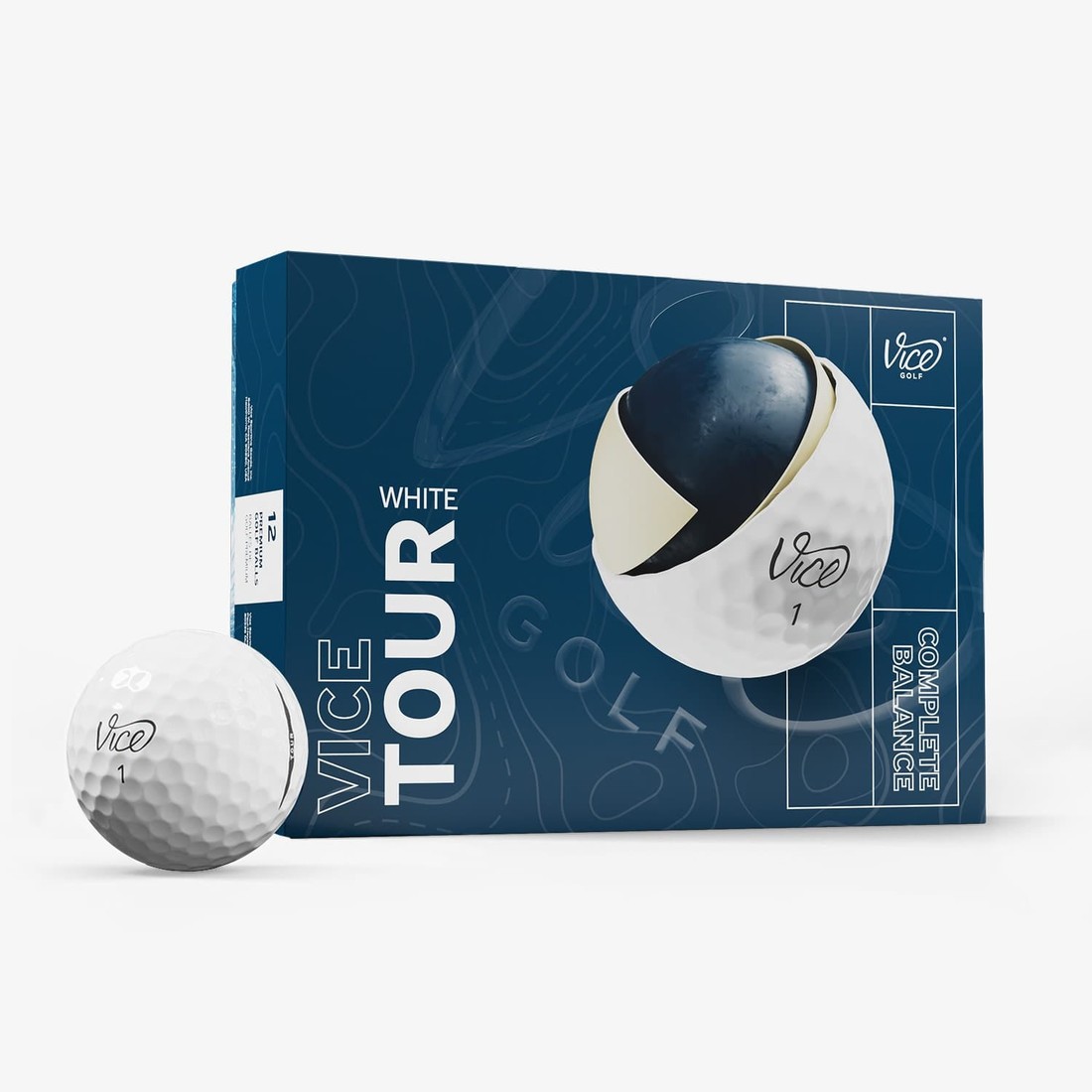
Vice built the Tour for golfers who want length and do not want to pay for it. Robot testing backs the plan: it flew farther than anything else in its category, and it still grabs on wedge shots.
What's new
Vice builds the Tour in three pieces under an ionomer cover and prices it per dozen at the value end of the market. The brand aims it squarely at players who care most about distance off the tee.
Compression measured 112, which is firm. Vice pairs that core with a spin profile split down the middle: low on approach shots, high around the greens.
How it plays
Off the tee, little in its price range keeps up. In a 62-ball robot test it went longest in its category at both 114 mph (271.4 yards) and 93 mph (208.3 yards), on the way to five awards. Another test placed it 13th of 44 off the driver at high swing speed.
Short game is the surprise. A 56 degree wedge produced 5,967 rpm, second in its category, so pitches and chips check up better than an ionomer cover would suggest. Distance scores 9 and value 9.6, the two numbers that matter most for this ball.
Where it lacks
Approach play is its weakest area. A 7-iron spun at 4,216 rpm in one robot test, and an earlier test ranked its 7-iron spin 50th, below the field average. Expect iron shots to release after landing rather than stop where they pitch.
Feel scores 7.7, the lowest of its six marks, and forgiveness trails at 7.9. A 112 compression core will feel stiff to anyone who prefers a soft-feeling ball.
“I would game this off the tee all day. Just expect your 7-iron to land and keep going.”- The Club Stand gear team
Reasons to buy
- Longest ball in its robot-test category at both 114 and 93 mph swing speeds
- Wedge spin of 5,967 rpm ranked second among three-piece club golfer balls
- Costs a fraction of tour urethane money yet beat 26 of 38 urethane models off the driver
Reasons to think twice
- 7-iron spin sits below the test average, so approach shots can release past the pin
- Measured compression of 112 makes it one of the firmer balls a slower swinger can buy
- Feel scores 7.7, its lowest mark, and the ionomer cover will not satisfy urethane loyalists
Specs
| Construction | 3-piece |
|---|---|
| Cover | Ionomer |
| Compression | 112 (measured) |
| Spin | Low approach, high short game |
| Best for | Value-minded players who want distance off the tee |
More balls we've scored
- Maxfli Tour X LS 2026 - 8.8/10. Maxfli's lower-spin Tour X, built for Ben Griffin and sold well under tour-ball money.
- Wilson Staff Model 2026 - 8.8/10. Wilson's four-piece urethane tour ball matches the longest models tested for distance and spins hard around greens.
- Titleist Pro V1 2025 - 8.8/10. Titleist's most-played ball gets a faster core and adds spin with irons and wedges.
- Callaway Chrome Tour 2026 - 8.7/10. A stiffer mantle gives Callaway's 2026 tour ball more speed without hardening the feel.
- Vice Pro 2024 - 8.7/10. A three-layer urethane ball that matched or beat the Pro V1 in testing for about mid-tier money.
- TaylorMade TP5 2026 - 8.6/10. A softer five-layer TaylorMade that ranked second for greenside spin among 62 robot-tested balls.