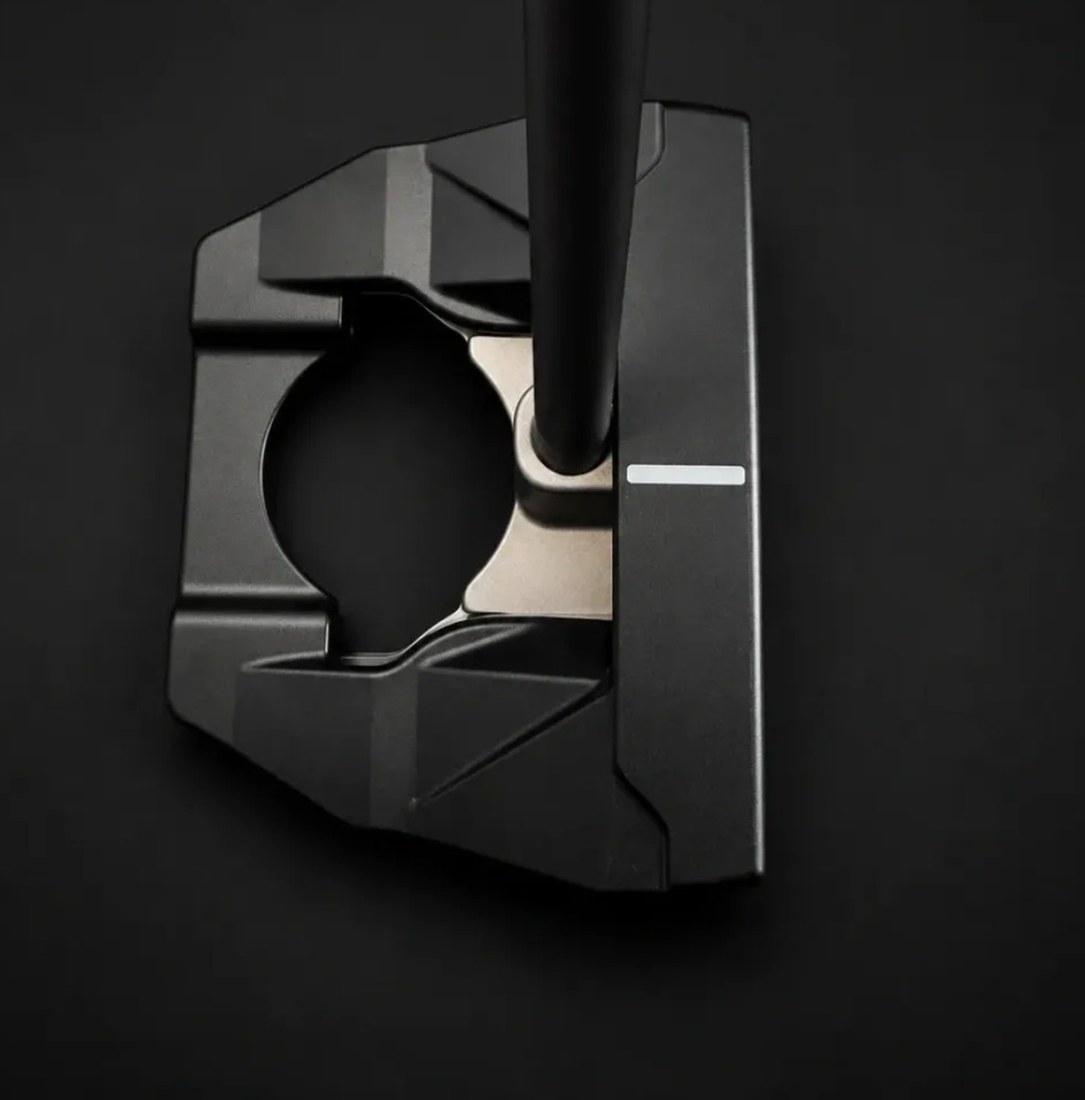
Pure Line designed the Moment Zero so your line is settled before you ever step in. Its zero-torque, center-balanced head tests well on short putts and on lag putts alike. The middle distance gives it trouble.
What's new
The Moment Zero arrived in mid 2025 as a zero-torque, center-balanced putter. Its head pairs 6061 aircraft-grade aluminum with 303 stainless steel, and a Kynetic Core sits behind the strike face. A small chamfer along the bottom of the face is there to keep it from snagging the turf.
Pure Line's headline idea is Vertical Alignment Advantage, a routine for positioning and aiming a lined ball while you stand over it. You can order it with a 3 Line, Multi Line, Racing Stripe, T Line, or single line aid, in 32 to 36 inches standard or 42 to 46 inches counterbalanced.
How it plays
Accuracy and forgiveness both score 8, which matches what a 26-putter zero-torque test found. It returned -6.6 overall, with -7.3 on short putts and -7.8 on long ones. On that scale a lower number is better, and those two figures are this putter at its best.
Golfers who own one keep bringing up the same two things: the head stays stable through the stroke, and the standing alignment routine gives them confidence over the ball. Nothing else rates as high as value at 8.5, and the money buys a putter that does its main job well.
Where it lacks
Medium-length putts fell off sharply to -3.8, with -7.3 and -7.8 sitting on either side of it. Distance scores 6.5, its lowest rating, and the mid-range dip matches that.
Feel and workability each land at 7.5. Neither is a problem, but neither stands out the way the aiming tools do, and golfers chasing soft feedback off the face may want more.
“It aims beautifully and holds its line, but I would want better speed on the in-between putts.”- The Club Stand gear team
Reasons to buy
- Among 26 zero-torque models tested, it returned -7.3 on short putts and -7.8 on long ones
- Vertical Alignment Advantage lets you line up a marked ball while standing, before you ever address it
- Five alignment aids and lengths up to 46 inches counterbalanced cover a wide range of setups
Reasons to think twice
- Medium-range putts slipped to -3.8, a sharp drop from how it handles both ends of the range
- Pace control needs work, since distance scores 6.5 and no other rating sits lower
- Feel and workability sit at 7.5, solid but short of its accuracy and forgiveness numbers
Specs
| Head | 6061 aircraft-grade aluminum with 303 stainless steel, center-balanced |
|---|---|
| Technology | Zero torque, Kynetic Core engineered behind the strike face, Vertical Alignment Advantage (position and align a lined ball while standing) |
| Face | Surface chamfer on the face bottom to reduce surface snag |
| Lengths | 32-36 inches standard; 42-46 inches counterbalanced |
| Alignment | Selectable aid: 3 Line, Multi Line, Racing Stripe, T Line, or single line |
| Best for | Aim-first players who want to confirm their line before stepping to the ball |
More putters we've scored
- Odyssey Ai-Dual S2S #7 2026 - 8.8/10. A zero-torque #7 mallet that beat 25 rivals at every putting distance, and it costs mid-tier money.
- Sub 70 011-SQ 2026 - 8.8/10. A milled aluminum zero-torque mallet that finished second of 26 on the robot without flagship pricing.
- TaylorMade Spider Tour X 2026 2026 - 8.7/10. Lighter than the Spider Tour, nearly as stable, and the most accurate putter in a 2026 test.
- TaylorMade Spider ZT Max 2026 - 8.6/10. TaylorMade stretches the Spider ZT into a bigger, higher-MOI head that keeps its face square on its own.
- PXG Torpedo ZT 2026 - 8.5/10. PXG takes the torque out of its Torpedo mallet without changing a shape players already know.
- PING Scottsdale TEC Ally Blue Onset 2026 - 8.5/10. A compact white mallet whose Onset hosel and top-rail dot keep a pull-prone stroke from drifting left.