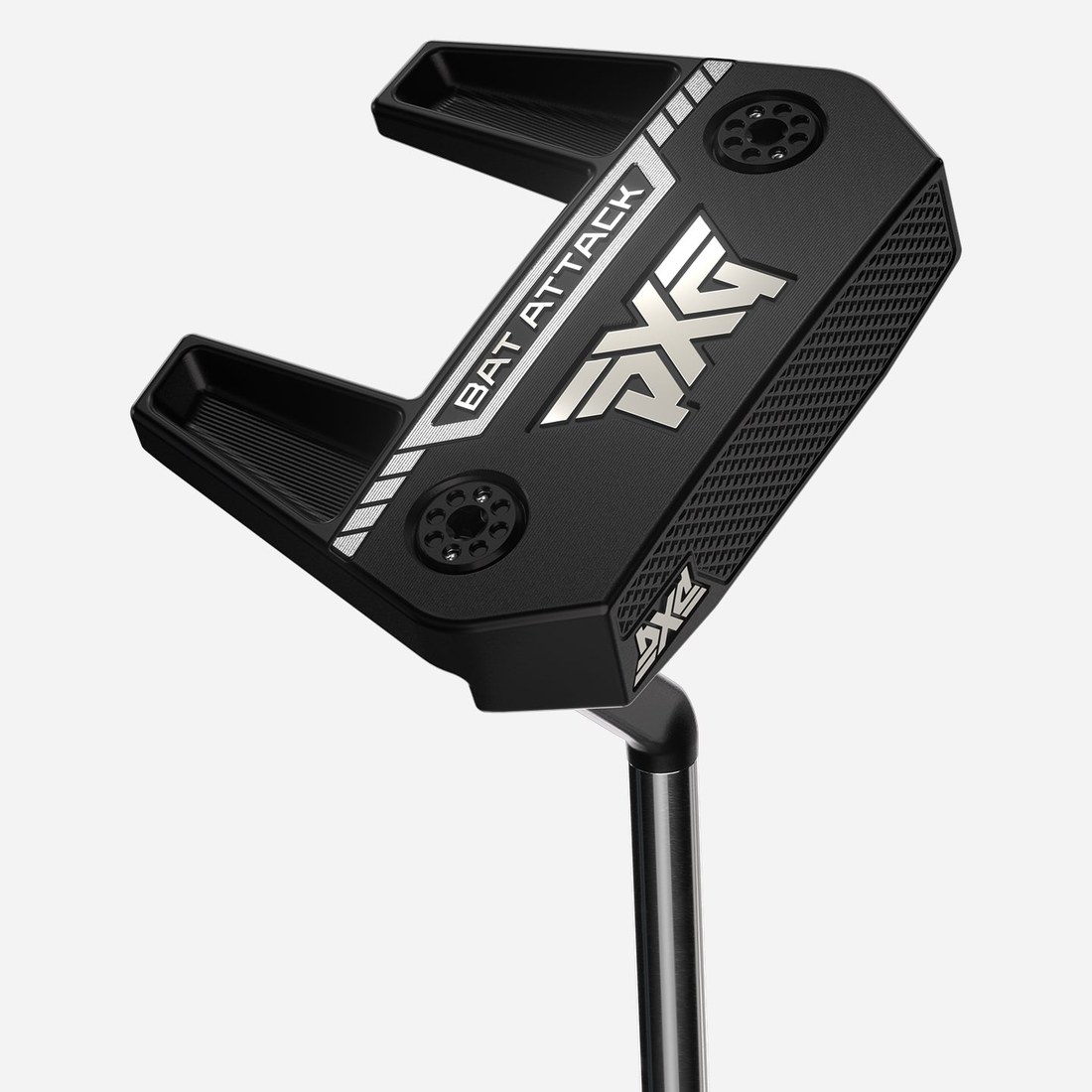
PXG took its iconic Bat Attack mallet and hung it on a zero-torque S-hosel. The 2025 result is aimed squarely at golfers who want the face to stop rotating.
What's new
PXG released the Bat Attack ZT in May 2025 as the second drop in its zero-torque collection. An S-hosel sets the shaft axis just above the center of gravity, and a 2 degree forward press comes built in, so hands sit ahead at address without any effort from you.
Underneath, a hollow 303 stainless steel body is about 31 percent S CORT polymer by internal volume, which lets PXG push mass out to the extreme perimeter. An ultra-thin pyramid-milled face and two adjustable sole weights finish the build. It sits at the bottom of PXG's zero-torque range on price, though nobody would call it cheap.
How it plays
Long putts make the case for it. From distance, PuttView scored it -8.8 in the 26-model zero-torque test, and on a scale where lower is better, that is a strong number. Short putts came in at -7.2 and the overall at -7.3.
Our scores follow the same line: 8.5 for forgiveness and feel, 8 for distance and accuracy. With weight spread to the perimeter, mishits hold their line, and the thin milled face earns its feel score.
Where it lacks
Mid-range putts drag the average down. A -6.0 from medium distance is ordinary, and it sits well behind what the putter does from long range, so its lag putting edge fades on the lengths you see most often.
Workability scores 6.5 because the design fights rotation by intent. If your stroke swings on an arc, this head works against you. Even at entry level in PXG's zero-torque line it carries a premium putter price, which holds value to a 7.
“We have seen few zero-torque heads better on lag putts. The mid-range numbers are a different matter.”- The Club Stand gear team
Reasons to buy
- Long putts scored -8.8 on PuttView in the 26-model zero-torque test, a strong result at distance
- Hollow steel body with S CORT polymer and perimeter mass gives it 8.5 marks for forgiveness and feel
- Two sole weights let you tune head weight and toe-heel bias to your stroke
Reasons to think twice
- Medium putts managed only -6.0, a middling figure that trails its lag and short-putt scores
- Workability scores 6.5 because the zero-torque design resists face rotation, which leaves golfers with an arcing stroke fighting the head
- Though it is the cheapest model in PXG's zero-torque range, it still sells at premium putter rates
Specs
| Head | Mallet, hollow-bodied 303 stainless steel with S CORT polymer (31 percent of internal volume), mass to the extreme perimeter |
|---|---|
| Technology | Zero torque, S-hosel with the shaft axis just above the center of gravity, built-in 2 degree forward press |
| Face | Ultra-thin pyramid-milled face |
| Weights | Two sole weights for head weight and toe-heel bias |
| Best for | Straight-stroke players who want the iconic Bat Attack shape without face rotation |
More putters we've scored
- Odyssey Ai-Dual S2S #7 2026 - 8.8/10. A zero-torque #7 mallet that beat 25 rivals at every putting distance, and it costs mid-tier money.
- Sub 70 011-SQ 2026 - 8.8/10. A milled aluminum zero-torque mallet that finished second of 26 on the robot without flagship pricing.
- TaylorMade Spider Tour X 2026 2026 - 8.7/10. Lighter than the Spider Tour, nearly as stable, and the most accurate putter in a 2026 test.
- TaylorMade Spider ZT Max 2026 - 8.6/10. TaylorMade stretches the Spider ZT into a bigger, higher-MOI head that keeps its face square on its own.
- PXG Torpedo ZT 2026 - 8.5/10. PXG takes the torque out of its Torpedo mallet without changing a shape players already know.
- PING Scottsdale TEC Ally Blue Onset 2026 - 8.5/10. A compact white mallet whose Onset hosel and top-rail dot keep a pull-prone stroke from drifting left.