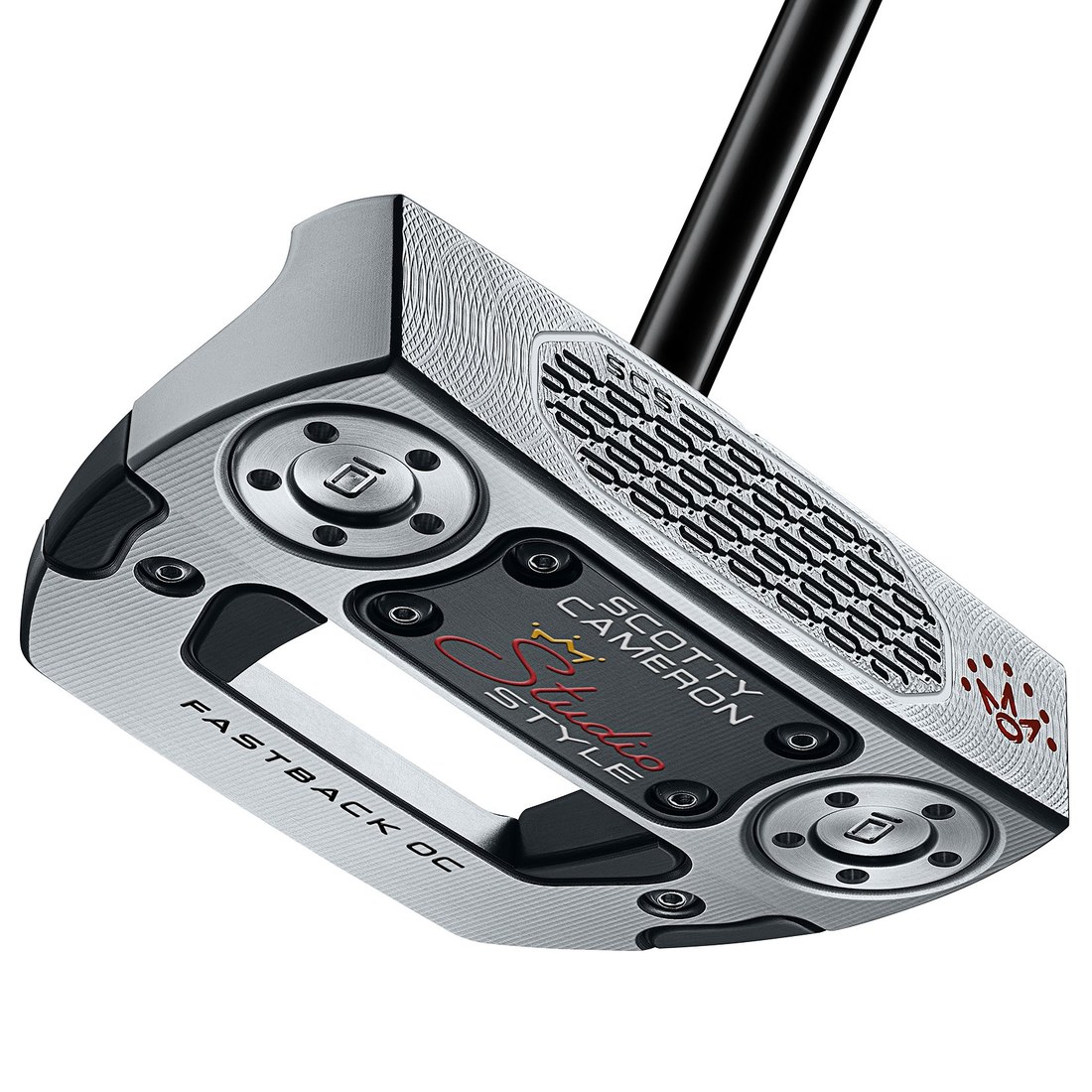
Scotty Cameron took the Fastback, a familiar mid-mallet shape, and gave it the Onset Center low-torque build. Feel earns an 8.8. From short range, though, no zero-torque putter we have data on did worse.
What's new
The Fastback OC reached shops in February 2026 as one of three OC models, alongside the 5 OC and 11R OC. OC moves the shaft back from the leading edge so it lines up with the head's front-to-back center of gravity, and adds 1 degree of shaft lean. The head then resists twisting, and the hands do less.
Underneath sits a ring-weighted mid-mallet in 303 stainless steel and 6061 aircraft aluminum, built 15 grams heavier than a standard Scotty head and paired with a custom black shaft to match. A Studio Carbon Steel insert with chain-link milling sits behind a single sight line, and it sells at full Scotty Cameron money.
How it plays
Feel is where the Fastback OC earns its keep. The carbon steel insert and chain-link milling give it an 8.8, far ahead of anything else on its scorecard.
Forgiveness and workability both land at 7, a fair return from a heavy, ring-weighted head built to stay steady. Distance control scores 5 and accuracy 5.5, so the pleasant sensation at impact does not translate into where the ball finishes.
Where it lacks
Short putts expose it. In a 26-model test of zero-torque putters, the Fastback OC finished last from short range, which is exactly where a face-stabilizing design ought to earn its place in the bag.
Its overall putting results in that test fell below the top-ten cutoff. Add a 5.5 value score at Scotty Cameron prices, and the argument for buying one rests almost entirely on feel.
“It feels wonderful at impact, then misses the short putts a low-torque head should make.”- The Club Stand gear team
Reasons to buy
- Feel scores 8.8, carried by a Studio Carbon Steel insert with chain-link milling
- Onset Center build sets the shaft back in line with the CG to help hold the face square
- Ring-weighted head runs 15 grams heavier than a standard Scotty, and forgiveness lands at 7
Reasons to think twice
- Ranked worst on short putts across a 26-model zero-torque field in independent testing
- Overall putting results in that same test fell below the top-ten cutoff
- Accuracy sits at 5.5, and premium Scotty Cameron pricing drags value down to 5.5 as well
Specs
| Head | Ring-weighted mid-mallet, 303 stainless steel with 6061 aircraft aluminum, 15 g heavier than standard Scotty |
|---|---|
| Technology | Onset Center (OC) low torque, shaft set back from the leading edge in line with the front-to-back CG, 1 degree shaft lean |
| Face | Studio Carbon Steel insert, chain-link milling, single sight line |
| Loft | 3.5 degrees |
| Lie | 70 degrees |
| Lengths | 33, 34, 35 inches |
| Shaft | Custom black shaft matched to the heavier head |
| Grip | Tapered Matador Mid |
| Best for | Players who want a traditional Fastback footprint with the face held square by the OC build |
More putters we've scored
- Odyssey Ai-Dual S2S #7 2026 - 8.8/10. A zero-torque #7 mallet that beat 25 rivals at every putting distance, and it costs mid-tier money.
- Sub 70 011-SQ 2026 - 8.8/10. A milled aluminum zero-torque mallet that finished second of 26 on the robot without flagship pricing.
- TaylorMade Spider Tour X 2026 2026 - 8.7/10. Lighter than the Spider Tour, nearly as stable, and the most accurate putter in a 2026 test.
- TaylorMade Spider ZT Max 2026 - 8.6/10. TaylorMade stretches the Spider ZT into a bigger, higher-MOI head that keeps its face square on its own.
- PXG Torpedo ZT 2026 - 8.5/10. PXG takes the torque out of its Torpedo mallet without changing a shape players already know.
- PING Scottsdale TEC Ally Blue Onset 2026 - 8.5/10. A compact white mallet whose Onset hosel and top-rail dot keep a pull-prone stroke from drifting left.