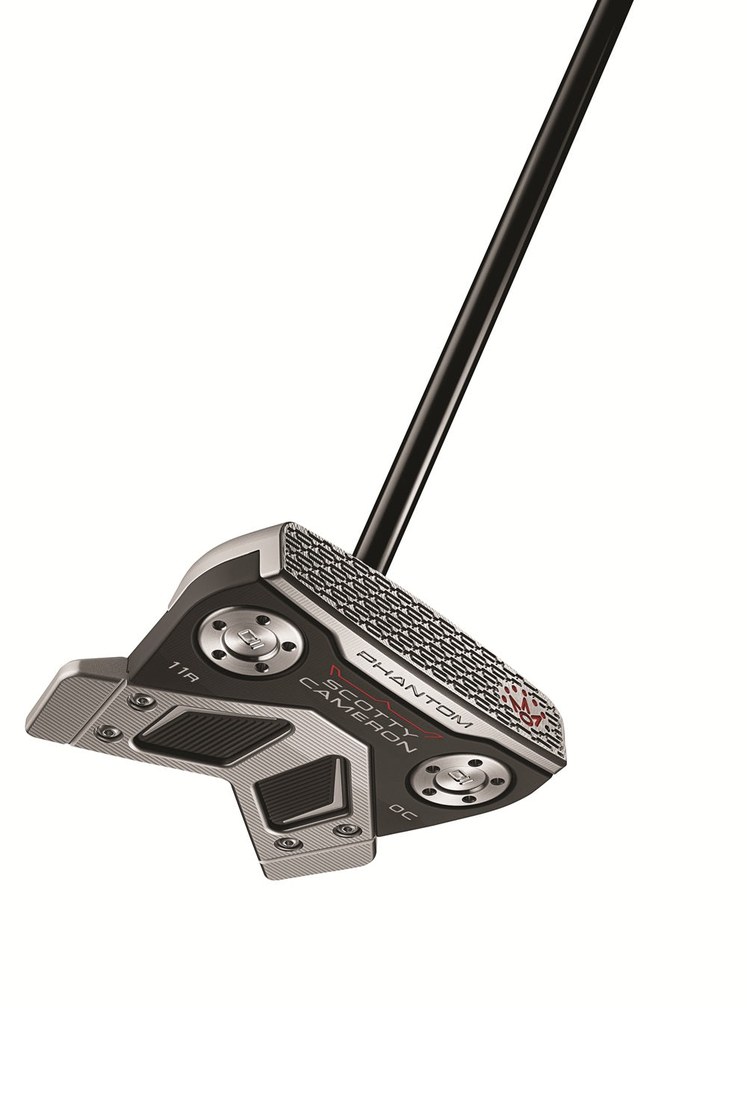
Scotty Cameron took its rounded Phantom 11 mallet and moved the shaft to the center of gravity. The result is a low-torque putter that feels like a Scotty and finished sixth of 26 in a zero-torque test.
What's new
The Onset Center build is new to the Phantom family for 2026. Instead of hanging off a heel hosel, the shaft enters at the center of gravity with 1 degree of forward lean, which is how Scotty gets the face to resist twisting during the stroke.
Underneath, a 303 stainless face and body sit on a 6061 aluminum sole and flange, plus two 15 g weights. Lengths run 33 to 35 inches on a KBS x Scotty Cameron shaft with a mid-size Matador grip. It costs a step more than the standard Phantom mallets, at the top of Scotty's pricing.
How it plays
Feel carries this putter. Its 8.9 is the best of its six scores, and the chain-link milling takes the click out of impact while still telling your hands whether you caught it thin or flush.
Forgiveness rates 8.5 because the heavy, center-shafted head shrugs off mishits and keeps the face pointed where you aimed it. In testing it did its best work from medium range and slipped on short putts, which left it sixth of 26 and a 7.6 for accuracy.
Where it lacks
Short putts are the soft spot. The test that ranked it sixth recorded its worst numbers from close range, a band where a premium putter should be at its sharpest.
Value scores 7.2, the lowest mark on its card. You pay top Scotty prices for a mid-table finish, and the forward lean asks for a session or two on the practice green before it stops feeling odd at address.
“It feels like a Scotty should, but short putts kept it out of the top five.”- The Club Stand gear team
Reasons to buy
- Keeps the rounded Phantom 11 look while adding the stability of a shaft set through the center of gravity
- Chain-link milling quiets the sound at impact without hiding where you struck it
- A heavy head holds the face square when contact drifts toward the heel or toe
Reasons to think twice
- Short putts were its weakest distance band in a 26-model zero-torque test
- Costs flagship Scotty money for a result that landed mid-pack in testing
- The built-in 1 degree of forward lean needs a practice session before it feels normal
Specs
| Construction | 303 stainless steel face and body / 6061 aircraft aluminum sole and flange |
|---|---|
| Face | Chain-link milling |
| Balance | Onset Center (OC), shaft through center of gravity, 1 degree forward shaft lean |
| Weight | Adjustable (2 x 15 g at 34 inches) |
| Loft | 3.5 degrees (+1 degree shaft lean) |
| Lie | 70 degrees |
| Lengths | 33, 34, 35 inches |
| Shaft | KBS x Scotty Cameron |
| Grip | Mid-size Matador |
| Best for | Straight-stroke players who want the Phantom 11 look in a low-torque build |
More putters we've scored
- Odyssey Ai-Dual S2S #7 2026 - 8.8/10. A zero-torque #7 mallet that beat 25 rivals at every putting distance, and it costs mid-tier money.
- Sub 70 011-SQ 2026 - 8.8/10. A milled aluminum zero-torque mallet that finished second of 26 on the robot without flagship pricing.
- TaylorMade Spider Tour X 2026 2026 - 8.7/10. Lighter than the Spider Tour, nearly as stable, and the most accurate putter in a 2026 test.
- TaylorMade Spider ZT Max 2026 - 8.6/10. TaylorMade stretches the Spider ZT into a bigger, higher-MOI head that keeps its face square on its own.
- PXG Torpedo ZT 2026 - 8.5/10. PXG takes the torque out of its Torpedo mallet without changing a shape players already know.
- PING Scottsdale TEC Ally Blue Onset 2026 - 8.5/10. A compact white mallet whose Onset hosel and top-rail dot keep a pull-prone stroke from drifting left.